
Spring 2026
Special Essay Showcase
Sponsored by the Kaisa Project
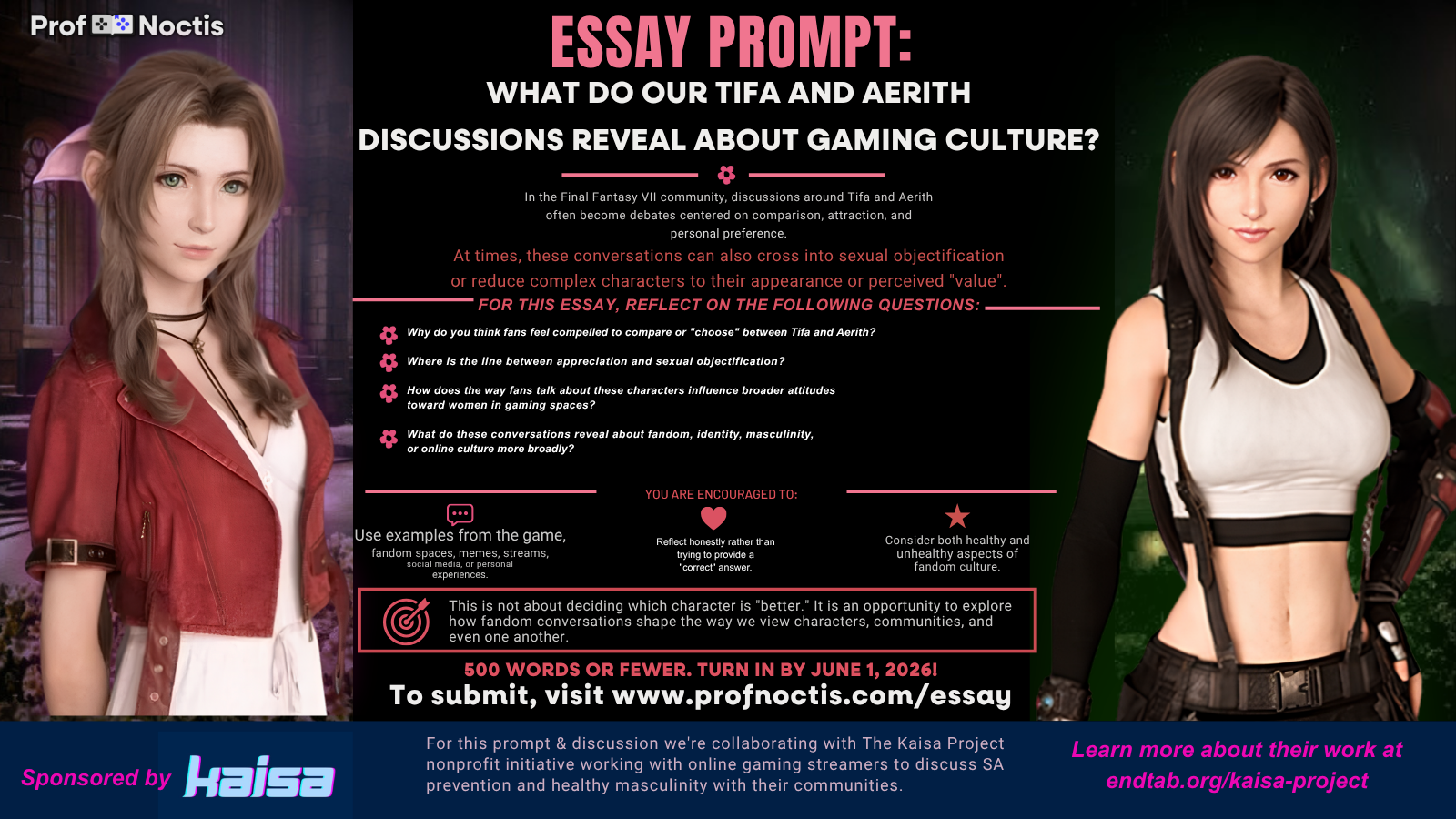
In spring of 2026, we partnered with The Kaisa Project, a research group focused on studying digital trends related to identity, sexual objectification, and harassment in online spaces. As a channel with particular interest in Final Fantasy VII, we chose to tap into our community to help this group gather research data. Essayists submitted responses to the prompt below (“What do our Tifa and Aerith discussions reveal about gaming culture?”). After collecting all essays, we sat down with The Kaisa Project Research Group to reflect on our findings. We encourage you to read all the essays, then tune into our episode with Katherine and Adam from Kaisa (at the bottom of this page).
A huge thanks to both Kaisa and our community for contributing to this important discussion!
COMMUNITY ESSAYS
Author: LoneWhiteMage
The classic Tifa vs. Aerith debate. We all have our preferences of which character has the more attractive appearance, and personality, which one is right for Cloud, and maybe even which one has the better gameplay. Some of us see parts of ourselves in these characters, some of us like to imagine which of these characters could be our significant other, and defend it fiercely because a criticism of our likes feels like a personal attack.
Sometimes it does seem surface level, like people loving Tifa because she is “the sexy one”, which was definitely my initial impression of her back when I first played the game, also influenced by seeing how others talked about her online. I mean, just look at the FMV cutscenes in the OG that feature Tifa, like the Weapons awakening FMV, or the ending FMV. And Aerith is sometimes just remembered as “the one that dies.” I feel because of FFVII’s popularity, a lot of people know about some characters and aspects of the game through passing without the nuance.
This debate is also a deliberate part of the game. You are given the choice to pursue whichever relationship you want, and it’s really just part of a larger trope in romance stories, especially anime romances. Tifa can fall into the “Childhood Friend” romance trope, and that character is almost never picked by the main character, and Aerith can be the “New, and exciting” love interest that the main character meets after the story has begun, (although these characters do break those cliches in some respects), and the game is actually encouraging you to choose.
I think back to a story I heard in which, from what I remember, Kazushige Nojima was surprised that a programmer who played the game thought that Tifa and Aerith didn’t like each other, so Nojima made sure to emphasize their friendship in Remake. Maybe it was just lost in translation, or maybe we are conditioned to see the two women in a love triangle scenario in a certain way.
With the dichotomy between these two characters, it’s inevitable that debates will arise over what a woman can, or should be: Modest vs. sexy, reserved vs. outgoing, and what a strong female character is. Should a female character be the tomboyish, physically strong kind, or the traditionally feminine, and spiritually strong kind?
And unfortunately these debates have lead to heated infighting, which in this age of the internet can include online bullying and death threats towards other fans and the creators. Casting a shadow on this fandom, and many other fandoms, which unfortunately tends to get the most attention online, giving people outside the fandom a negative perception. Passion for these two characters, or any aspects of a story is certainly a double-edged sword.
Author: Winteralba
I will start out by saying, I love Tifa, and I love Aerith. They both are physically attractive, supportive, and for the most part emotionally stable. The issue I have with the majority of the discussion is that there is often no room for the opposite side. You cannot be right thinking that Aerith/Tifa is the love interest of Cloud, because Tifa/Aerith is. If there is no right answer, then why do we choose?
The compulsion to choose between them comes from the necessity to feel heard. To feel validation in our opinion, and receive gratification from the community around us agreeing. While that is healthy, it is often transformed into sexual objectification.
Where is the line between appreciation and objectification? When discussions are about how they are characterized in a scene, the design of their outfit or dress, or theories on how they would react to hypotheticals it mainly could be considered appreciation. Depending on the subject matter of the hypotheticals, those conversations often skew further into objectification. Many do not understand the difference between fetishization and creative thought.
While a conversation about how they would react to going to college could start innocent and focus on what they would major in, or if they would play a particular sport. Some in the community would see it as an opportunity to ask leading questions into sexual objectification. Lustful thoughts are natural, and as a community people shouldn’t feel shunned for having them, but discussing these things online has to be mutual. Shame is also natural and healthy, and understanding how to accept it and grow from it is a crucial part of life for all peoples.
Regardless of Sex, people should understand that feeling ashamed of your actions isn’t a sign to back away and hide, or lash out and say hurtful things. It’s a time to acknowledge that you misread the situation, and understand that whatever it is that brought you shame, is not appropriate. Being attracted to characters that are designed as Love Interests is not something to be ashamed of, but trying to push your appetite on those around you is.
Some of the most enjoyable conversations I’ve had with people about these characters have been with fan artists. People that spend hours upon hours drawing them, designing cloths and unique takes on their original design. They appreciate them in healthy ways, by creating things inspired by them, and our conversations have all been about our theories for Part Three. No fetishization, no objectification, just appreciation for their art, and the material that inspired it.
author: John I
Final Fantasy 7 falls somewhere in between a linear narrative and a role-playing game. Cloud is clearly defined by the writers with a distinct narrative and character arc. However, the player is allowed to – at least somewhat – define the nature of Cloud’s relationship with the other major characters. Because we are given this agency, we take these decisions and their outcomes personally. They aren’t just Cloud’s, they feel like ours too. The most intense of these connections are those that Cloud has with Tifa and Aerith given the romantic undertones that accompany the interactions with both. As a result, they are also the ones that inspire the most intense emotions in the player. Naturally, when presented with two options most people will develop a preference for one or the other.
This differences in preference will just as naturally lead to argument about which is “better”. I don’t believe there is anything inherently wrong with this debate. Whenever a narrative leaves ambiguity, fans will engage in argument over interpretations. It can even be healthy; opening our mind to different facets of the art and entertainment we love and sharpening our abilities for ideation and argumentation. Tifa and Aerith are different characters, and they reveal different aspects of Cloud’s character. When the conversation is focused here it is at its best – what each character means to and teaches us about Cloud and the larger themes of the narrative.
The issue is that we have largely forgotten how to have this conversation appropriately. To me, this is primarily an issue with social media and online communication in general. Anonymity and the simple reality of putting thoughts into a black box rather than directly to another person remove a lot of the guardrails that enforce good behavior. Consequentially, conversations on this topic can descend into some rather unsavory places. This unfortunately creates something of a feedback loop – words shape thoughts and thoughts shape actions. The more one speaks inappropriately (even just typing it out online), the more they will think that way and eventually act that way.
It doesn’t have to be that way; we can be better. That requires accountability: from each other and to ourselves. It is not easy or pleasant to confront a friend on their misbehavior, or to honestly reckon with our own. But if we want to enrich our enjoyment of the art and entertainment that we love and encourage others to engage with it, it is a necessity. Final Fantasy 7 is a beautiful story and Tifa and Aerith are likewise beautifully written and inspiring characters. We do the work and ourselves a disservice by failing to engage with it thoughtfully and within the bounds of polite debate and discussions.
Author: Mrs.M.
⬥ My perception: Square Enix inspired fans to “choose” between team Tifa and team Aerith. The game Developers encouraged this fan behavior from the beginning. In the English version manual, packaged with PlayStation Final Fantasy VII (1997); under Aerith’s character bio: “. . .her unusual abilities enable her to use magic, but she seems more interested in the deepening love triangle between herself, Cloud and Tifa.”
Before even playing the game, prospective gamers are exposed to game teasers and trailers introducing this game’s love triangle tensions. It is natural for fans to be compelled to start discussing this tension and choosing a side. Glancing now at the two major shipping sub-Reddits for each respected fictional woman, combined users make at least 400 contributions per week. That’s quite a bit of internet traction and this active engagement also favors Square Enix too. This discussion encourages and compels some fans to “choose” either Tifa or Aerith. It was by-design, intentionally.
■ I was online and witnessed the first look reveal for Remake’s new rendered character models. To put it bluntly, some fans weren’t happy with Tifa’s new attire, spats and other edits. As a woman, I felt gross reading certain online comments. One 2019 Reddit comment burns in my memory; the poster described Tifa’s bra cup size, ad nauseam. Aerith was target too. Watching reactions to a cut-scene in Remake; Aerith stood in front of Cloud in her red dress. A male YouTuber replies, “Oh- the side leg- the saucy, tasteful, how high can it go? … side leg.” That unsettling, sinking feeling happens to me when character appreciation slips into objectification.
⬥ An online expression applicable here: “Don’t feed the Trolls”. You may encounter off-putting opinions online; respect your time and do not engage with those commentors. Instead, focus more on the makers. For instance, the writers of Final Fantasy 7 Remake trilogy wrote the Tifa and Aerith characters so brilliantly many in the ProfNoctis community have written numerous essays on their friendship alone. That is how to influence broader positive attitudes toward women in the gaming space. Encourage your creative output team to be more cognizant on the female-prospective and gain some distance from the fans. Trying to please every fan with one solution is impossible; many fans are hard to please. As a fan myself, my best advice is to trust your creative team and their vision for their characters.
■ Conversations swirling around Aerith and Tifa reveal many things about our human behavior. Some feedback is cringe-worthy, and some is awe-inspiring. A father in 2020, while COVID-19 was devastating Earth, shared his exuberant joy with the fandom by snapping a grinning photo and informing Redditors he had recently named his daughter, Aerith. As for the characters, Tifa and Aerith; my hope is their fanbase matures a bit and takes a more sensible approach regarding these characters in future forums and platforms.
Author: Dustman
Well I figured I would throw my 2 cents in as well so here we go. I think the reason the FF7 community feel so compelled to pick between Tifa and Aerith really boils down to their personal preference. Now that could be based on their looks or their personality traits. The problem I can’t seem to grasp is why people get so hostile in these conversations. I feel like the ones who are vocal and hostile act a bit parasocial towards these characters. I have always had the mind set that Cloud had feelings for both and had Aerith lived who knows what/if he would choose either of them in that scenario.
However because Aerith died it strengthened his bond to Tifa and she became his shoulder to cry on and they became each others support system. I also have a feeling that originally the Developers wanted the player to choose between them them when FF7 became its own franchise they kind of had to choose for the player to push the story forward. Crisis Core came out and we learned Zach and Aerith had serious feelings for each other and I think is when it became clear to me that Aerith really only felt anything towards Cloud because he reminded her of Zach. Then we have some who plainly prefer Tifa because of well, her assets. And that can be fine I think but it’s when that is the main or only reason a person has for preference. I don’t think this is only a game issue because as a dude I have heard so many people talking about the reason they like someone is simply because of their looks. I think these conversations are normal and fine it’s only when things get hostile or people get upset at someone else’s opinion. Everyone has the right to be vocal about their preferences in a partner, however it’s when people become violent when what I like isn’t what they want me to like.
FF7 is a great example of a fandom that at times is one of the greatest fandoms but when certain subjects are brought up it can become toxic. I really feel like online culture over the last couple years has become hard to be around because all we seem to see are the bad that drowns out the good. This may sound corny but we all have to remain positive and just ignore the people who thrive off of confrontation.
Author: Chocobro
As is typical of anime, the game presents a protagonist, two potential romantic interests, and indecisiveness.
Even if the outcome is not affected, we are compelled to choose. However, both options have merits and (few) demerits, making it a difficult decision.
This difficulty evokes our most intimate and personal opinions and preferences, and by participating in online discussions, we also gain access to the intimate thoughts of strangers.
Peeping through this keyhole, their lives are revealed and exposed to our judgment.
We do not like being judged, but it is a small price to pay for the opportunity to be the judge as well.
“Reveal” implies acquiring knowledge that you did not have before.
Shipping discussions reveal the immaturity some people carry unresolved.
Or our intolerance.
But in truth, all of this was already known.
People did not become intolerant overnight with the advent of SNS.
We are unprepared for the sheer numbers and start building biases against common sense.
After growing some skin, we learn to glance over things. We are no longer rage-baited.
But by then, we are scarred for life. Any contrary opinion becomes an omen of a toxic exchange, so we preemptively judge the other as stupid and steer clear of further problems.
Among many things, those discussions reveal how unprepared we are for social life.
SNS is merely a hideout for antisocial people who, for some reason, did not expect to have social interactions.
Being social means dealing with the “different” (← made-up definition, because why not?).
We go online, we join communities and fandoms, we make teams.
This is merely “hiving” disguised as being social.
I have already had enough of shipping discussions revealing how antisocial I am.
It is time to make an effort and let them reveal how social I can be.
And at the center of the storm, we have our beloved characters.
The word “objectification” implies that the target has been stripped of any characteristic that we deem ourselves deserving of.
As humans, we have a natural bias:
humans > animals (not intelligent) > objects (not alive)
Among other things, we believe that humans have the right to choice and happiness; animals, only happiness; objects, nothing at all.
Tifa and Aerith were made as objects—pretty models that appeal to different fantasies of male teenagers.
As proper objects, they should be used as we wish. And so they are:
lonely individuals idealize them to fulfill unrealized dreams;
activists reshape their personalities in order to convey a message;
businesses keep putting them through hardships for profit.
Objectification is not only sexual in nature; it exists everywhere.
But it all stops with empathy.
When we put ourselves in the place of the “target,” we begin rejecting the idea of doing things we would not do to ourselves.
Animals should not live in cages.
Characters should not be handled frivolously.
Only then do Tifa and Aerith stop being admired for what they offer.
They become admired because that is what we want for ourselves.
Author: Tim
What the discussions about Tifa and Aerith reveal is that prior assumptions can and will completely change the conclusions two people draw from the exact same information. They reveal that the old joke about sectarian violence “Northern conservative baptist great lakes region council of 1912? Die Heretic” about how those who differ in opinion from you in the most minor ways seem the most vile and must be villainized is unfortunately true and practiced today. It reveals patterns of Zero-sum thinking, or that the ends justify the means.
I am wary of painting with too broad a brush regarding any particular fandom, but the shipping elephant in the room does need to be addressed as so much of the discussion about FF7 is influenced by the idea that one’s preferred woman must have influenced the position one holds. For an example I saw literally today, someone against the idea that 7R was a sequel was accused of wanting that only because it meant Aerith would not be revived and thus not be a threat to the Cloud/ Tifa pairing and fandom.
As these discussions reveal an assumed malice or vileness in an ‘opposed’ or even ‘neutral’ stance, they also reveal the opposite, an assumed goodness in those who share this extremely minor viewpoint, even if their words, actions and viewpoints would otherwise be wholly at odds. Many times people in these fandoms – and many others – have gone to bat for horrible people purely because they were in the same “camp.”
As for the attacks on both women, often by other women who accuse Tifa and Aerith of being examples of misogynistic writing, while saying vile things, it reveals that people can often completely compartmentalize their thinking. Saying it’s not misogynistic to reduce either woman to their body or accuse them of being prostitutes because it’s just pixels.
Notably, these are not things these discussions alone reveal. They are also found in the fandom discussions of series like Bleach, Naruto, X-men, and many more. They show up in power scaling discussions between Spider-Man and Deku from My Hero Academia. They show up in discussions of Star Wars vs Star Trek. Tifa and Aerith is certainly a discussion full of vitriol- any fandom that is even perceived to have a love triangle, or even invents one whole cloth seems prone to develop this type of thinking – but it’s hardly unique to love triangles, or even discussions of women. It arises in different ways in different fandoms, but I think ultimately what it all boils down to is the very simple idea is that for a lot of people they want their favorite to be the best and the most special and having to share the spotlight with another character or worse, lose it to another, rankles them. Thus they seek ways to embiggen their favorite while reducing the other however they can think of.
It’s the tribe versus the other, but the tribe is your fave. Or sometimes your waifu.
Author: Naminesfriend
Since the late 1990s, admiration and contention within the Final Fantasy 7 community concerning the two leading women has been at the forefront of people's minds. Love triangle debates, backstories, and context clues into each woman's character have all attributed in conversations about the game as a whole. The discussions we have online as a Fandom about Tifa and Aerith often time will reflect people's views on women as a whole, or how they feel a preference towards a "type" of ideal version of a woman. This stems from the fact that both Tifa and Aerith were created thematically to show not to judge a book by it's cover; Tifa wears revealing clothes but is actually quite shy and traditionally feminine, while Aerith wears cute girly clothes but is actually very assertive and go getter. To invert appearance with personality means that we as an audience have to dive deeper and face these women as multifaceted people, something all women in real life are. But much like a reflection of how women are treated in real life, people will place their perceptions onto women and force them through as though that is the truth at face value. This can create conflict within a space and at times will objectify or demean women when demanding preference between them.
The reason people compare Aerith and Tifa so much is because they act as dual heroines. Aerith is the external plot's heroine while Tifa acts as the internal plot's heroine, and lead the story in that regard. Despite this, Cloud is technically the point of view and protagonist we as the player see the world in. This also reflects how Cloud views the women and how he navigates the interpersonal relationships with both, at times even fumbling with understanding them in specific circumstances. Those relationship dynamics and what it reveals about Tifa and Aerith showcases them both in a beautiful light that's different from each other, because they have lived different lives outside of Cloud and we as an audience can see. But we do have clues within the game and their dialogues through Cloud to see more about them. This mystery is a natural draw to the audience and makes you as the player want to choose to get to know them better, under the guise of developing the relationship they have with Cloud further when in reality you as the player just wish to know more about Tifa or Aerith.
There is an inherent problem found within this framework. A "waifu"-ification if you will, where a piece of media will showcase women in their best qualities that appear attractive enough for the audience to "choose" them to idolize them, many times in a sexual manner. On the other hand, Fandom is enjoyable because people online in a community can do deep dives into characters and be delighted in learning about these women as complex individuals, ones they root for them to have happier endings. Two sides, same coin.
Author: Solah
The discussions around Tifa and Aerith reveal a lot about how gaming fandoms can turn fictional characters into symbols of identity, desire, and conflict. On the surface, the debate is usually framed as a “ship war”: who should end up with Cloud? But I do not think this rivalry appeared only because fans naturally wanted to fight over two female characters. It was also encouraged by the way Square Enix built Final Fantasy VII around emotional ambiguity. The original story leaves room for interpretation, and the company has often played with that ambiguity. At the same time, the Remake trilogy seems to be trying to correct part of this tension by giving more weight to Tifa and Aerith’s friendship, showing that their relationship does not need to exist only through Cloud.
There is nothing wrong with appreciating a character’s beauty, charm, or sensuality. Saying that Aerith looks sensual in her red dress, or that Tifa looks elegant and attractive in her blue dress, can be a simple compliment. The problem begins when the character stops being treated as a person within the story and becomes only a body, a fantasy, or a weapon in fandom arguments. When a small piece of fabric covering a character’s bust becomes a debate about “censorship,” or when fans insist on turning one of them into a tradwife fantasy who must belong to a man, appreciation crosses into sexual objectification. It reduces complex women to what they can offer visually or romantically to others.
This affects the broader atmosphere of gaming spaces. Many women already enter fandoms expecting to be judged, mocked, or dismissed. When fans treat a female character as “used,” “impure,” or morally wrong simply because she moves forward with her life five years later, it reinforces the idea that women’s value depends on loyalty, sexual purity, or attachment to a man. Even though some women in the fandom also participate in this objectification, that does not make it less harmful. It creates a loud and uncomfortable environment where misogynistic ideas are repeated as jokes, memes, or “opinions,” but still shape how women feel in those spaces.
These conversations also reveal the parasocial side of fandom. Fans project their own values onto Tifa and Aerith, then use them as extensions of personal identity. Liking one character becomes less about interpretation and more about belonging to a side. From there, the discussion can become aggressive: people harass others, chase them out of spaces, and treat disagreement as betrayal. In many cases, the rivalry is not really about Tifa or Aerith as characters, but about the need to control them through a male partner.
What this reveals is that fandom can be meaningful and creative, but it can also reproduce the same sexism found outside gaming. Tifa and Aerith deserve to be discussed as full characters, not just as prizes in Cloud’s story.
author: Andrew Gregory
I was thirteen years old the first time I saw a grown man argue online about Tifa Lockhart’s breasts like the future of civilization depended on cup size consistency. That is the strange thing about Final Fantasy VII. The game quietly encourages this behavior while simultaneously warning about it. And Cloud was the literary representation of that. The lead was Cloud. This is a structural functional and fundamental principle of how the game is designed. Tifa preserves continuity. Aerith creates transcendence. The women remember, guide, soothe, challenge, and emotionally regulate the protagonist while Cloud occupies the glamorous role of wounded centrality. So from a conflict theorist’s standpoint, we can never segregate the women of Final Fantasy 7 from their masculine influence.
Tifa and Aerith Gainsborough were constructed for the gaze and purposes of men building a functional dystopian model in which the lead, a byproduct of society, could become a protagonist. They are connective tissue holding together a world that is ecologically collapsing, spiritually hollowed out, corporately dominated, and psychologically fragmented. Their original narrative identities were built around stabilizing fractured masculinity: structural anchors for a dissociated protagonist assembled from false narratives and corporate violence. The Gold Saucer date sequence turns affection into arithmetic. Pick the right dialogue options. Raise the hidden values. Win the scene. The player is not observing romance. The player is being taught to optimize it. And we did.
By the early 2000s, nude mods for Tifa had already appeared online: jagged polygons and impossible anatomy stretched across graphics cards wheezing like asthmatic lawnmowers. Digital bodies had become public property, endlessly alterable and endlessly negotiable. Then came Final Fantasy VII Remake and suddenly everyone was arguing again. Sports bras. “Censorship.” Authenticity. Entire ideological battlefields constructed around a woman made partly of pixels and grief. The technology changed but the instinct did not.
As for the two: Aerith was never really ours in the first place. Series creator Hironobu Sakaguchi has spoken about how the death of his mother influenced her themes and the Lifestream itself. We spent decades trying to possess a character fundamentally written around loss. Meanwhile, Tifa’s devotion is not healthy either. She obsesses over Cloud, coddles him, lies for him, preserves him, and reconstructs him when he collapses. Many players interpret that as romance because the fantasy is not really about love. It is about emotional permanence. Someone who remembers us correctly. Someone who absorbs our instability and remains anyway.
The “fandom” reconstructed these characters beyond their original purpose. Through fan art, tribalism, cosplay, memes, localization changes, and decades of parasocial projection, the audience performed recursive authorship. The characters now exist simultaneously as original text, corporate reinterpretation, and fandom-authored mythology. Final Fantasy VII understands that fantasy better than the audience ever did.
One woman was built to preserve masculine continuity. The other was built to interrupt it. Both have evolved via social construction… but neither of them are real.
Author: Braedberi
Why do players pit Tifa against Aerith and what does that teach us about gaming culture? The comparison tends to resonate with the Madonna/Whore dichotomy; Aerith the "pure," Tifa the “sexual desire.” Gamers identify with a woman who matches their emotional ideas or desires. This option reveals how gaming culture continues to treat women as less actual, real women and more symbolic positions, but who are they really?
Fans tend to treat Aerith as the “Madonna”: flower girl, healer, sacrificial figure, and wrongly viewed as a trad wife. But it’s her true character that turns this on its head. FFVII Remake Ultimania dubs her “playful, bold, and emotionally perceptive,” reinforcing her agency and mischief over saintliness. In game, she’s not some tradwife; she wants things, she’s hilarious and apropos, she’s spunky, and on her own terms. She helps pull Cloud out of his shell.
Tifa, is put on the “Whore” side of the dichotomy, not because of anything she’s done, but because some of the fandom focuses on her appearance created in the 90s, which admittedly comes off as more misogynistic. Her look becomes a shortcut for objectification. But in the narrative, she’s Cloud’s emotional anchor. Hamaguchi spoke on Tifa’s role: “One of the ways we grounded him in these scenes is having Tifa close by … he even asks her after Gongaga that if she sees him getting out of hand, please remind him that he needs help pulling himself back.” In Advent Children Reunion Files, writer K. Nojima mused, “…Cloud and Tifa would be together. Everybody would be living back home where they belonged.” That’s how the creators thought of her more as a partner and a stabilizing force. This isn’t objectification; this is emotional support, interdependence. Standing in direct contrast to the reductive sexual framing certain “fans” see her in.
As we can see, both women resist the labels that some want to place on them. However, the way fans talk about them unfortunately depends on who you are talking to; from my personal experience, newcomers and most “cloti’s:” people who pair Cloud and Tifa seem to have the best read on the girls. Newcomers see them for who they are rather than “historical” figures with baggage. Though when seen through the proper lens, these two women help broaden and redefine how women are seen in gaming, which I can only imagine is more representative.
In the end, fans tend to compare Tifa and Aerith because each woman is used as a projection of identity, desire, and ideals. The distinction between appreciation and sexual objectification contrasts when admiration moves from narrative depth to treating womeen as symbols to debate. These discussions unpack how fandom negotiates masculinity by showcasing each girl's feminist qualities, shaping the wider mindset about women in gaming spaces, while unfortunately normalizing competition and the expectation that female characters exist to be chosen. In the end, they reveal how online culture mediates and defines identity performance, tribalism, and the policing of femininity.
Author: Spencer W. Pennington
Even after a near-thirty-year timespan, Final Fantasy VII remains as beloved, debated over, and consequential now as it was in 1997. The female characters at the heart of the game, Tifa Lockhart and Aerith Gainsborough, fit that same description. Furthermore, Tifa and Aerith became not only fan-favorites, but also video game sex symbols, not unlike Tomb Raider’s Lara Croft. In ways both positive and negative, Tifa and Aerith have become player surrogates for their fans. This shifting archetypal representation has only grown more apparent amongst fans since the release of Final Fantasy VII Remake and Rebirth.
In one sense, Tifa and Aerith are aspirational: As different as their personalities and skills are, both women represent a type of female character that is well-rounded, imbued with agency, and successful. Despite their traumas, neither are damsels in distress; both Tifa and Aerith are able to successfully strike back at the oppressive forces around them, be it Shinra or Sephiroth. Additionally, they are sources of strength: When Barrett is in despair after Sector 7’s destruction, or when Cloud is enduring psychological collapse, it is these women who serve rallying points for the party.
In another respect, Tifa and Aerith fill the void of connection for players. This feels especially relevant in a world defined by political chaos, social upheaval, and economic instability – a reality which mirrors that of the characters’ existence in FFVII. Furthermore, even with today’s technological advancements, many people all over the world feel increasingly isolated. In light of this, I argue that, for male players in particular – especially those first coming to FFVII through the remake series – Tifa and Aerith have not just become fictional crushes, as they were in the past, but almost digital love interests. Such a relationship to Tifa or Aerith could create a reality where the player’s understandable desire for companionship is unfulfilled.
For all the agency that Tifa and Aerith have within FFVII, their domain does not extend beyond that: They are fictional characters in a fictional world and, although they are relatable, they are not human. Though unintentional, such idealizations can create unrealistic expectations of women. This could occur not only physically, but emotionally: Real women, like men, not only comfort their partners, but challenge them; they possess flaws, have differing worldviews, and reach for their own goals. Tifa and Aerith do none of these things in relationship to the player.
All of this considered, it is not hard to understand why such idealizations of Tifa and Aerith occur, be they as heroines, love interests, or something else. In a world where the player’s reality is increasingly digital, it is no wonder that they might seek out meaning in the world of Final Fantasy VII and its characters. Perhaps their fans are so devoted because Tifa and Aerith embody what the player aims to be, who the player hopes to one day meet, or because they possess qualities that the player hopes to possess.
Author: Wynn
I believe people are prompted to choose between Aerith and Tifa because of the original set up (however dated it might be). The problem comes in with what is actually presented with character development, cloud vs false memories, actual feelings vs. what we the audience are watching happening. I think a big problem is that people view Tifa as being more than she actually is, and all the actual chemistry in the game being with Aerith in the games presented. It doesn’t help that everything is optional to a point. The devs can’t commit to any one idea over the other for fear of losing one audience or the other. Imo clerith is clearly intentional and beloved by the devs but audiences want to do the wish fulfillment of Cloti a lot of the time instead. I’ll always choose Aerith because to me Cloti is unhealthy.
Author: Luluslullaby
Discourse surrounding Tifa and Aerith are reflections of how patriarchal norms encourage women to be pit against each other rather than recognized as equal individuals. Especially with the ubiquity of shipping as a topic of discussion within FF7 Communities online, the other woman is often turned into somebody to criticize or score points on rather than to analyze or accept holistically or with empathy.They are both in-universe victims of issues that plague our reality, but because of the framing of choice and the assignment of value to women ending up bordering on their usefulness and proximity to men, these facets are undermined in exchange for caricatures of their real identities. Because of socialization and norms around gaming culture, women have long been discouraged from entering these spaces, a lot of the more toxic and overtly misogynistic facets of this discourse hail directly from men.
The constant objectification of Tifa is a central example of how this behavior manifests, and the way conservative men end up being drawn to her by aesthetics alone and ignore the nuance of how she was radicalized by being a victim of capitalism as shown in TOTP as well as the destruction of Nibelheim being a byproduct of Sephiroth’s inherited colonial mindset becomes irrelevant. And in the context of shipping many facets of her arc contorted to describe her as a liar, a manipulator, a woman with no self worth who will take whoever comes at her. Likewise the painting of Aerith’s nuances as a survivor of genocide, governmental experimentation and surveilance, as well as her own struggle with socialization and reconciling loss both of individuals as well as her volatile relationship to the lifestream is completely doused in fantasies about her or setting her to the side and relegating her as an annoyance because she is a disruption to said fantasy. Her playfulness and the dichotomy of her attitude with her environment and the tragedy surrounding her is contorted into being perceived as promiscuous, unfaithful, an attention seeker unable to read the room and an utterly selfish individual.
Neither of these women are allowed to exist as full characters because in a cultural landscape like ours they aren’t privy to that. The fact that they each have their own arcs not centered on men but the discourse very much is male-centered speaks to that fact. Appreciation for character’s appearances becomes objectification when it is one’s sole focus on a character rather than an aside. One can absolutely be attracted to a character and be cognizant of their totality, but that is seldom the case when women in real life don’t even have the privilege to be seen as more than an object.. And the aforementioned shipping strategy to put down one woman and paint them unfavorably rather than acknowledging the efficacies of Aerith or Tifa as a partner to Cloud and the characterization of each dynamic, the nuance is lost. The death of critical thinking makes shipping as character analysis exceptional instead of conventional.
Author: Lutra
Fans feel compelled to choose between Tifa and Aerith simply based on their uncontrolled core sexual preferences. These subconscious desires run so deep that fans probably feel the need to defend their emotions when others disagree with them or choose the other side. The player wants to see their own preference become the story and the woman they like best to be the main romantic interest in the plot. Particularly, some men want a more modest woman like Aerith that is more the homemaker type, while other men want that strong sexy sporty girl like Tifa. Women may also want to relate more with the character type that more reflects themselves, or is like their friend or sister/mother type, thus creating an emotional connection for women as well. Resulting in the same effect that women would want their preferred character to be present and dominate in the plot of the story, sometimes as a self insert for the woman.
Appreciation becomes sexual objectification only when the player decides to disregard and throw away all the value of the character’s personality or appeal simply for the visual aesthetics that are not just based on physical traits that are pleasing, but rather solely for the emotional arousal alone. If the player only cares that the woman (or man) is naked, almost naked, and has giant breasts or a massive bulge, then the line is being crossed. One can appreciate a character that has these things, but also requires that the player has some sort of emotional connection to that character beyond the sexual elements. Tifa is the prime example of the more sexy woman character with larger breasts to tease men, but she has a kind and gentle personality and takes care of Cloud. Since her character has appeal beyond her breast size, people would maybe tend to objectify her less.
Women in gaming spaces could be affected by the conversations around these two characters in these sorts of ways: If a girl wants to become a streamer/popular, she may see that dressing more sexually and revealing more of her chest with low cut shirts, like Tifa, she probably will gain a much larger following than if she were to dress more modest like Aerith. I believe that the sexual appeal is more powerful when trying to be present in an online space, which is where most gaming happens now. Gaming is no longer something you get together in-person to do at someone’s house around an N64 or a convention tournament. It’s all online. Thus, if a woman wants to be noticed or “desirable” to men in the gaming space, she needs to be the skinny, sexy, scantily dressed, and bubbly personality character, regardless of reality.
These conversations reveal that fandoms create micro-chasms of radical ideology, focused insanely on preferred characters or narratives. It reveals to men who may think more deeply about their preferences, that if they like more motherly figures vs sexual ones, what type of men they are. Is it less masculine to prefer Aerith over Tifa? Online is where the worst types of people are given an amplifier and the most insane fan-made takes become canon. People need to become more humble and kind online. Though asking someone to like a character that visually is unappealing to them, is a hard ask. The culture can become less toxic, if they are willing to be more human.
Author: zenogias
First impressions carry more weight than we like to admit. Clothing defines personality, role, and morality. In videogames this reflects deliberate choices by the creators to convey identity, status, and narrative function.
Aerith is dressed in a conservatively feminine style emphasizing softness, kindness, and nurturing qualities. Other characters who share this design are her mother, Elmyra, and figures like Lucrecia and Shera, whose long white coats resemble dresses and lend a maternal idea. In FFVII, women seen as wives, partners, or mothers are consistently dressed in ways that show traditional femininity.
By contrast, Scarlet’s provocative red attire signals villainous danger and allure. Elena and Cissnei wear professional uniforms that mark them as Turks projecting competence. Jessie’s military greens show her rebel identity, while Yuffie and Kyrie’s youthful outfits brim with personality, reflecting their teenage energy. Even in Rebirth, Cissnei’s updated look emphasizes leadership, with clothing that convey readiness for action rather than domesticity.
Tifa, however, stands apart. As a bartender, her original design reveals more skin than any other female cast member. In the Remake, black tights temper this, but in the original game her bare legs, thighs, and midriff made her outfit the most minimal of the party. Yuffie also shows her midriff, but her accessories give her a more conservative air compared to Tifa’s simplicity. This design choice has led to Tifa being sexualized more than any other FFVII character.
Screenshots with her outfit, paired with her default expressions, often evoke sultry or seductive impressions. Imagine her in Rinoa’s more feminine attire from FFVIII with the same expression and perhaps one would see it as feminine rather than sensual.
Aerith’s clothing leaves little room for interpretation, she is the archetypal princess figure. Tifa’s design invites projection. She can be seen as a working-class woman, or more problematically as someone using her appearance to attract customers like the way Hooters uniforms function.
The tragedy of Tifa’s design is that her clothes obscure her competence. Her outfit communicates little of her strength. As a result, she is too easily dismissed as eye candy, her depth hidden beneath surface impressions.
In Traces of Two Pasts, they attempted to counter this by grounding Tifa in hardship with the loss of her family, medical debt and solitary lifestyle. Despite her beauty, she rejects the easy path of Wall Market exploitation, choosing instead poverty and dignity. Even when selling steamed buns at train stations, her initial appeal may have been her face, but her survival depended on diligence and competence.
Perhaps the most telling example comes from Rebirth. Bugenhagen treats Tifa’s account of the Lifestream with skepticism, while cherishing Aerith. Was this difference born of appearance? Aerith looks the part of someone special, a figure to be protected. While Tifa is burdened by the perceptions her design invites.
Square Enix’s choices were not accidental. It shaped how players interpret these women, and in Tifa’s case, they created a lasting tension between her outward image and her inner strength.
Author: celestialbuddies
Being part of a group gives us a sense of belonging. The social identity theory is a psychological theory where people define their identity largely by the groups they belong to. The group the person belongs to is called the ingroup, and other people belong to the outgroup. We tend to see the ingroup in a better light than the outgroup, no matter how randomly the groups are assigned. We wish for the ingroup’s success, but even more for the outgroup’s failure. The sides of a shipping war can be seen as such groups.
As soon as someone new dips their toe into the fandom, people will be looking for signs of which ship they support or want to ”recruit” them. This makes picking a side feel like a mandatory part of being a fan. In a polarized space, saying the wrong thing, such as ”hey, this character is cool”, to the wrong crowd, might get interpreted as something more and create a wave of hate threads. Picking a side and staying within that bubble will feel safer.
Games are built to immerse the player and make them feel like they’re actually there. It’d be naive to think that misogyny towards fictional characters couldn’t translate to the same attitudes and behavior towards real women—and some shipping arguments can truly be called that—misogyny.
Some people say that Aerith only loves the parts of Cloud that resemble Zack. If you ask me, this sounds a lot like saying that Aerith likes muscles and a big sword, since Cloud behaves nothing like Zack. He has his cool act, but Aerith quickly sees through it, having immense emotional intelligence. Aerith isn’t shallow enough to only think about material things. She is also slut-shamed for moving on from a teenage relationship with a guy who ghosted her for years, which is ridiculous.
Some people say Tifa was only made to be eye candy. When I first saw her, that’s what I thought too, and I instantly disliked her character. In doing that, I also put her appearance first and didn’t focus on what mattered. I acted like the people I criticize, which is embarrassing to look back at. So what if Tifa was made to be beautiful? It doesn’t mean she can’t have a deep story worthy of analysis and appreciation.
Finding a character attractive is fine and can be an innocent, enjoyable part of gaming. Reducing the character to their external characteristics is where we tip into objectification. The entire shipping conversation sometimes feels like it lessens these well-written characters into mere accessories for the player: “Which flavor of girl would you like? Shy and caring or playful and headstrong—take your pick!”
In the shipping community, the people on the same side, the same ingroup, are seen favorably, yet the other possesses certain negative traits such as “they can’t read” or “they’re just plain stupid”, and therefore their arguments are automatically invalid. This limits the possibility of conversing respectfully.
Now that you’ve read the essays
Check out our conversation with the researchers at The Kaisa Project. Katherine and Adam shed light on what the data in these essays suggests and help us think through themes present in the community. Be sure to head over to Youtube to like and subscribe. And if you want to join the conversation with your own thoughts, leave a comment. Thanks for being a part of this class!